"Timbit" Carbon Taxes and Net Zero Goals Limit Canadian Economy says Friends of Science Society
PR Newswire
CALGARY, AB, April 27, 2026
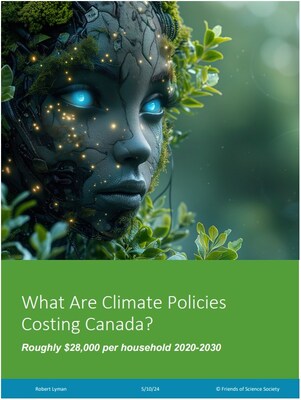
CALGARY, AB, April 27, 2026 /PRNewswire/ -- The Canadian Climate Institute claims that the industrial carbon price amounts to only a "Timbit" per barrel of costs (value ~CAD 0.50) and that there is almost "zero" economic impact on households; these claims are disputed by Friends of Science Society in a new video explainer, "Timbit Carbon Tax". Friends of Science Society's report "What are Climate Policies Costing Canada?" reveals that climate action to 2030 is estimated to cost taxpayers $476 billion, a far cry from the cost of a Timbit.
Prime Minister Carney set the consumer carbon tax, then $80/t, to zero on his first day in office, but the industrial carbon tax remains.
Presently Ottawa and the province of Alberta are negotiating an MOU for a new pipeline from the Alberta oil sands on the basis of a carbon price of $130/t, in contrast to Canada's largest trade partners. The USA has no carbon tax. Canada does ~80% of its trade with the US. The next largest single country trading partner at 4%, China, has a carbon price of about $20/t. Trade with the European Union sits at about 8-10%.
As outlined in two Friends of Science Society reports written by retired energy economist, Robert Lyman, this burden of tax and price disparity limits Canada's competitiveness. Prime Minister Carney is also encouraging the Alberta oil sands operators to 'decarbonize' oil, by building a massive, multi-billion-dollar Carbon Capture Underground Storage (CCUS) facility, known as the "Pathways" project of the Oil Sands Alliance. Commenting on the MOU, in "Unruly Ducks: What will it take Premier Danielle Smith to get them all in a row?," Lyman notes that these costs are largely passed on to consumers.
Friends of Science Society produced a video titled, "Can we decarbonize oil?" critiquing this carbon removal method as being of value for carbon traders, but ineffective to address climate change. As reported by the New York Times on April 16, 2026, Microsoft, the largest purchaser of carbon removal credits, has paused such activity. Friends of Science Society suggests that this puts Carney's bid for 'decarbonized' Canadian oil into question. A 2022 Friends of Science Society report on Carbon Capture and Storage discusses the implications for taxpayers. Much of the Pathways project would be tax subsidized for billions.
In "The Invisible Industrial Carbon Tax," Lyman writes: "Many Canadians think that the carbon tax has been eliminated. They are unaware of the complexity and cost of the carbon pricing regime imposed on Canadian firms, of the magnitude of the costs and of the misallocation of resources it causes."
An April 22, 2026, Western Standard op-ed by Lennie Kaplan, outlines the impact the Carney-Smith Net Zero emissions will have on Alberta and Canada. Kaplan is a former senior manager of Fiscal and Economic policy within the Alberta government.
Carbon taxes and CCUS are premised on the thesis that carbon dioxide from human industrial emissions are driving global warming and climate change. To meet Paris Agreement targets, climate activist asset managers and investors have encouraged major corporations to create Net Zero plans and comply with Environment, Social, Governance (ESG), something that American state attorneys general are pushing back on. Friends of Science Society outlined similar concerns in an Open Letter to the Office of the Superintendent of Financial Institutions, particularly noting the retracted Kotz et al (2024) climate damage study employed by the Network for Greening the Financial System (NGFS) central banks.
Climate policy analyst Roger Pielke, Jr., published a two-part Substack on a new paper: "The empirically inscrutable climate-economy relationship."1 He writes: "Curtin-Burgess (CB26) ask a straightforward question: Can we actually measure how climate affects the economy from the historical record?...Their answer is no."
This brings into question the conclusions drawn by JP Morgan's March 2026 report, "Tipping Points: Decision making under deep uncertainty".
Tom Harris of the International Climate Science Coalition presented at the recent Heartland Institute climate event, reviewing data analysis of climate records that show Canada is not warming at twice the global average as frequently claimed. Friends of Science Society asks if the scientific evidence does not support the climate claims, why is Canada on this noncompetitive path?
About
Friends of Science Society is an independent group of earth, atmospheric and solar scientists, engineers, and citizens that is celebrating its 23rd year of offering climate science insights. After a thorough review of a broad spectrum of literature on climate change, Friends of Science Society has concluded that the sun is the main driver of climate change, not carbon dioxide (CO2).
Friends of Science Society
PO Box 61172 RPO Kensington
Calgary AB T2N 4S6
Canada
Toll-free Telephone: 1-888-789-9597
Web: friendsofscience.org
E-mail: contact(at)friendsofscience(dot)org
Web: climatechange101.ca

 View original content to download multimedia:https://www.prnewswire.com/news-releases/timbit-carbon-taxes-and-net-zero-goals-limit-canadian-economy-says-friends-of-science-society-302753888.html
SOURCE Friends of Science Society