
Newman’s Auto Body & Repair is publishing consumer guidance explaining why diagnostic scanning can become part of collision repair before work begins and again after applicable repairs are completed. The November resource focuses on how pre-repair and post-repair scans can provide different information about electronic systems on modern vehicles and why scanning is not the same as physically inspecting collision damage.
Modern vehicles can contain numerous electronic control modules connected to systems throughout the vehicle. Depending on the make, model, equipment, and collision location, these modules can communicate with components associated with airbags, driver-assistance technology, lighting, steering, braking, cameras, sensors, and other vehicle functions.
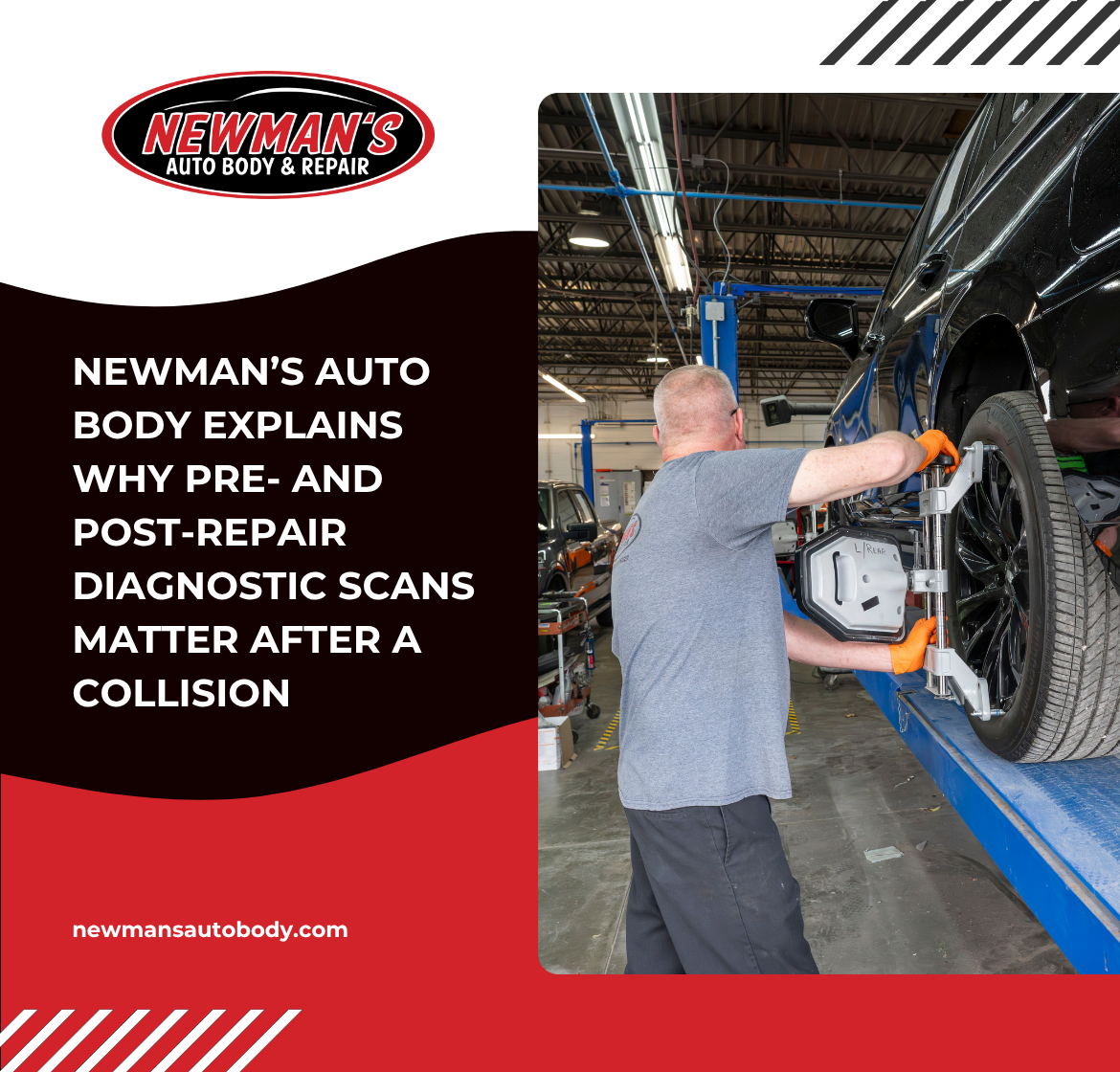
Newman’s Auto Body & Repair explains that its collision repair services can include diagnostic procedures when they are applicable to the individual vehicle and repair. The purpose is not to assume that every stored diagnostic code represents collision damage, but to gather information that can be considered alongside physical inspection and manufacturer repair procedures.
A pre-repair diagnostic scan takes place before applicable collision repairs are completed. It can provide technicians with information reported by vehicle systems at that stage of the repair process.
That information can help establish a diagnostic starting point. If the vehicle reports diagnostic trouble codes or other system information, technicians can evaluate those results in the context of the collision, visible damage, vehicle equipment, and applicable manufacturer procedures.
A scan result alone does not determine the complete repair plan. Electronic diagnostic information cannot replace inspection of a bent component, damaged mounting location, cracked panel, displaced sensor, broken connector, or other physical condition.
The November guidance therefore distinguishes diagnostic scanning from collision damage analysis. Physical inspection documents the condition of collision-affected components, while scanning provides information available through the vehicle’s electronic systems. Depending on the repair, both can contribute different information.
Pre-repair scanning can become particularly relevant because electronic components may be positioned within common collision zones. Cameras, radar units, parking sensors, wiring, and modules can be located around bumpers, mirrors, windshields, grilles, doors, and other exterior areas.
A damaged bumper, for example, does not automatically mean every sensor or electronic component behind it has failed. A pre-repair scan also does not independently prove that a reported fault was caused by the accident. Technicians can consider diagnostic information together with the collision location, component condition, and vehicle-specific procedures.
Manufacturer information is important because scanning requirements can vary among vehicles. Automakers may specify diagnostic procedures before repairs, after repairs, or following particular component removal, replacement, or programming operations.
This is one reason a procedure appropriate for one vehicle should not automatically be applied to another. The make, model, model year, equipment configuration, collision damage, and work being performed can all affect which diagnostic procedures belong in the repair plan.
Newman’s Auto Body & Repair provides additional information about manufacturer-focused repair requirements through its OEM certification information. Researching applicable procedures helps connect diagnostic operations to the specific vehicle rather than treating scanning as a universal checklist.
Post-repair scanning serves a different point in the repair sequence.
After applicable collision repairs, reassembly, and other required procedures have been completed, a post-repair scan can provide updated information from the vehicle’s electronic systems. Technicians can compare that information with the repair plan and determine whether applicable diagnostic conditions associated with the repair require additional attention.
The purpose is not to guarantee that a scan can identify every possible vehicle condition. Diagnostic scanning reports information available through supported electronic systems. It does not replace physical quality-control checks or confirm unrelated mechanical and cosmetic conditions throughout the vehicle.
The distinction between diagnostic scanning and calibration is also important.
A diagnostic scan communicates with vehicle systems to retrieve information such as diagnostic trouble codes and other available data. Calibration is a separate procedure used when applicable cameras, radar units, sensors, or related systems require specified operating parameters to be established or verified.
Completing a diagnostic scan does not automatically satisfy a calibration requirement. Likewise, the presence of driver-assistance technology does not mean every collision requires calibration. Manufacturer procedures, affected components, and repair operations determine which procedures apply.
Repair sequencing can connect these operations. A collision repair may involve physical damage analysis first, followed by disassembly, component repair or replacement, refinishing, reassembly, diagnostics, and applicable calibration or verification procedures. The exact sequence depends on the individual repair.
Post-repair scanning can also provide documentation at the end of applicable electronic work. This gives technicians another source of information to consider before vehicle delivery, particularly when repairs involved components or systems that communicate through electronic modules.
Newman’s Auto Body & Repair offers separate post-repair inspection services, providing additional context for the distinction between diagnostic information and a broader physical review of completed collision repairs. A post-repair inspection can consider the work performed and condition of repaired areas, while diagnostic scanning focuses specifically on information available through vehicle electronic systems.
The November guidance organizes scanning around a straightforward three-stage framework. Before repairs, applicable scanning can establish electronic information available at the beginning of the process. During repair planning, technicians can compare diagnostic findings with physical damage and manufacturer procedures. After applicable repairs, a post-repair scan can provide updated system information for review before completion.
This framework helps consumers understand why two scans performed at different stages are not necessarily duplicates. Each captures electronic information at a different point in the collision repair process.
It also explains why scanning should be viewed as one part of modern damage analysis rather than a substitute for the entire inspection. Collision repair can involve body structure, exterior components, wiring, electronics, restraint-related equipment, driver-assistance technology, and other systems. Each requires the evaluation appropriate to the vehicle and documented damage.
Newman’s Auto Body & Repair’s November publication adds pre- and post-repair diagnostic scanning to its broader consumer collision repair information. The central message is that scanning can help document electronic system information before and after applicable repairs, while physical inspection and manufacturer procedures remain necessary for determining what the individual collision repair requires.
Newman’s Auto Body & Repair provides collision and auto body repair services from its Hamilton Circle facility at 1551 S Hamilton Cir, Olathe, KS 66061.
###
For more information about Newman's Auto Body & Repair - Hamilton Cir, contact the company here:
Newman's Auto Body & Repair - Hamilton Cir
Zack Newman
(913) 768 1300
zack@newmansautobody.com
1551 S Hamilton Cir, Olathe, KS 66061