Hanbat National University Researchers Find Way to Improve OLED Efficiency and Lifespan
PR Newswire
CHUNGCHEONG PROVINCE, South Korea, Nov. 11, 2026
Researchers tune a thin internal layer to reduce charge-related light loss and extend OLED device lifetime.
CHUNGCHEONG PROVINCE, South Korea, Nov. 11, 2026 /PRNewswire/ -- Organic light-emitting diodes (OLEDs) power many display screens, but their efficiency can be limited by energy lost inside the device. As organic layers are deposited, their molecules can align to create an internal electrical potential known as giant surface potential (GSP). When this potential draws excess positive charges, or holes, near the light-emitting layer, they can interfere with light-producing excitons. This process, called exciton–polaron quenching, reduces emitted light and can affect device performance.
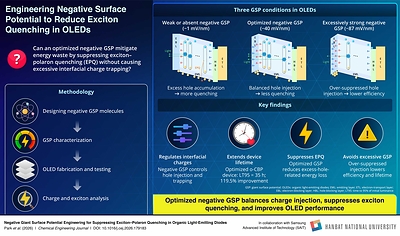
A research team was led by Professor Jae-Hyun Lee from the Department of Creative Convergence Engineering at Hanbat National University, Republic of Korea, along with Dr. Jong Soo Kim from the Samsung Advanced Institute of Technology. The researchers placed thin electron-blocking layers (EBLs) between the hole-transport and light-emitting layers to adjust the local electrical environment. They compared materials with negative GSP values of −1, −40 and −87 millivolts per nanometer, using electrical measurements, impedance spectroscopy, transient electroluminescence, and photoluminescence to examine charge movement and light loss. This paper was made available online on July 7, 2026, and was published in Volume 545 of the Chemical Engineering Journal on October 1, 2026.
The measurements showed that negative GSP could counter the emitting layer's positive potential and regulate unwanted hole injection. Impedance and transient electroluminescence data revealed that the stronger the negative GSP, the more holes were held at the interface with the emitting layer. The o-CBP layer, with a GSP of −40 millivolts per nanometer, provided the best balance in the tested devices. "The key is to control the interface potential between layers, rather than simply using a material with the strongest GSP," said Prof. Lee.
The strongest negative GSP was not the best option. PhCzCz-PhTPS, at −87 millivolts per nanometer, trapped holes strongly at the interface and also restricted charge injection too much. This reduced current and the likelihood of forming light-emitting excitons, lowering efficiency and shortening device lifetime. By contrast, the o-CBP device reached an LT95 lifetime of 35 hours, compared with about 29 hours for the reference, approximately 20% longer. LT95 measures the time for luminance to fall to 95% of its initial level under the study's test conditions. "Our results show that an intermediate negative surface potential can reduce energy loss while preserving the charge flow needed for light emission," said Prof. Lee.
The findings suggest a design strategy for OLED technology: treat interfacial electrostatics as an adjustable property, not simply a consequence of the materials. Better control of charge accumulation could support energy-efficient displays and longer-lasting screens in smartphones, televisions, monitors and emerging foldable or wearable devices. However, these experiments tested OLEDs under laboratory conditions; they do not establish longer battery life, reduced burn-in, or improved image quality in commercial products.
Overall, the study shows that negative GSP should be tuned to the surrounding layers, not maximized. This principle may also inform other organic electronics where interfacial charge accumulation contributes to energy loss. Further testing across device designs and operating conditions is needed to determine how broadly the approach can improve real-world display performance.
Reference
Title of original paper: Negative giant surface potential engineering for suppressing exciton–polaron quenching in organic light-emitting diodes
Journal: Chemical Engineering Journal
DOI: https://doi.org/10.1016/j.cej.2026.179183
About the institute
Website: https://www.hanbat.ac.kr/eng/
Media Contact:
Seyoung Jang
82-42-828-8461
 View original content to download multimedia:https://www.prnewswire.com/news-releases/hanbat-national-university-researchers-find-way-to-improve-oled-efficiency-and-lifespan-302935961.html
SOURCE Hanbat National University