GenScript Biotech Global Forum, "Scripting Possibilities", Convened AI and Biopharma Leaders in San Francisco
PR Newswire
PISCATAWAY, N.J., Jan. 29, 2026
Panel discussions brought to life important insights into how AI could change the face of biopharma drug discovery in 2026 and beyond
PISCATAWAY, N.J., Jan. 29, 2026 /PRNewswire/ -- GenScript Biotech Corporation, a global leader in life sciences R&D and manufacturing services, successfully concluded the 2026 GenScript Biotech Global Forum on January 14 in San Francisco during the annual J.P. Morgan Healthcare Conference. Held under the theme "Scripting Possibilities – The Future of Therapeutic Innovation," the Forum convened close to 1,000 international attendees. The Forum explored how artificial intelligence is reshaping discovery and what it will take to scale innovation responsibly and reliably.
"The conversations throughout the day reinforced that biotechnology is indeed at an inflection point, but they also sharpened what that means in practice," said Ray Chen, PhD, President of GenScript Life Science Group. "What emerged clearly is that speed, precision, and collaboration only create impact when they are embedded into real workflows, real laboratories, and real operating models. We're proud of the role this forum played in bringing together leaders who are not just imagining what's next but actively shaping how innovation will scale and endure. The discussions at this year's Biotech Global Forum helped set a pragmatic, forward-looking agenda for how biopharma will translate possibility into progress throughout 2026 and beyond."
Aylin Kosova Bilgin, Chief Marketing and Corporate Communications Officer of GenScript, officially opened the forum by reinforcing GenScript's Scripting Possibilities vision and the industry's shift from AI experimentation to real-world execution. She encouraged attendees to keep asking "What if?" as the catalyst for breakthroughs that can be built, scaled, and trusted.
Fireside Chat: Scripting Possibilities for AI in Healthcare and Protein Engineering
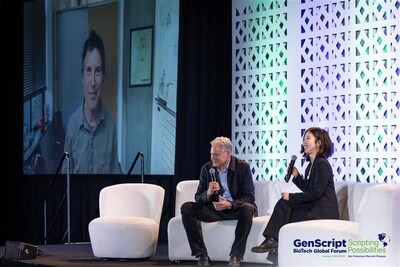
Following Ms. Bilgin's opening remarks, a fireside chat featuring Nobel Laureate David Baker, PhD, and Eric Horvitz, MD, PhD, Chief Scientific Officer of Microsoft, examined how AI is reshaping the front end of biological discovery, particularly in protein design.
Key Insights Included:
- While AI is accelerating hypothesis generation and helping scientists focus more quickly on the most viable protein designs, durable impact will depend on rigorous experimental validation, access to high-quality data, and a deep understanding of biological complexity.
- How computational protein design is expanding what's possible beyond naturally occurring templates, enabling increasingly customized proteins with a growing range of potential applications.
- Progress depends on rapidly converting AI-designed concepts into DNA and proteins for experimental validation—powering the design-to-validation loop that sustains iterative discovery.
Scripting Possibilities on the Next Frontier: Cell Therapy
The Forum's cell therapy panel explored how the field is advancing beyond early approvals, with increased focus on patient experience, durability, and real-world feasibility. Panelists from DeciBio, AstraZeneca, Legend Biotech, and Stylus Medicine emphasized execution priorities (manufacturability, consistency, turnaround time, and scalable delivery) as the space evolves.
Key Insights Included:
- A comparison of ex vivo therapies with the promise of in vivo engineering, including safety, delivery (viral and non-viral), and regulatory considerations that will shape adoption.
- Durability and payload needs vary by indication, and panelists discussed next-gen progress across biology, delivery, and access including advancing approaches for challenging settings like solid tumors.
- The continued shift of CAR-T into outpatient/community care, cost reduction through automation, and the importance of faster regulatory pathways.
- The discussion reinforced that the next phase of cell therapy will be defined not by novelty alone, but by the ability to deliver scalable, durable therapies that work in real-world care settings.
Scripting Possibilities to Enable AI in Drug Discovery
Leaders from NVIDIA, Absci, Jefferies, and Amazon discussed the shift from AI experimentation to enterprise-scale adoption, emphasizing that value will come from embedding AI into end-to-end discovery workflows rather than isolated pilots. Anthony Costa, PhD, Director of Digital Biology at NVIDIA, noted that effective AI strategies depend on clearly defining the task at hand and selecting the appropriate approach for each stage of discovery.
Key Insights Included:
- The importance of connecting computational insight directly to laboratory execution, where models inform experiments and results feed back into the system.
- How tighter integration between AI outputs and real-world lab workflows can help translate AI promise into repeatable, scalable discovery impact.
- Panelists agreed that AI will only scale when it becomes part of the discovery workflow itself, rather than an external or experimental layer.
Scripting Possibilities to Secure Biotech's Future: AI, Trust & the New Global Reality
The final panel, consisting of experts from Sidley Austin, Treehill Partners, Capgemini, and Mike Walker Consulting, examined how trust, governance, and geopolitical awareness are becoming foundational to scaling AI in biopharma. Thorsten Alexander Rall of Capgemini cautioned that "proofs of concept don't scale," underscoring the need to move beyond experimentation toward enterprise-ready operating models.
Key Insights Included:
- Governance and compliance should be viewed as enablers rather than constraints, particularly as regulatory scrutiny and cross-border considerations increasingly shape how organizations manage risk, protect intellectual property, and sustain innovation.
- AI will not scale without trust, and governance and global awareness must be designed in from the outset to enable responsible, durable adoption.
"This year's theme, Scripting Possibilities, reflected a shared recognition across the industry that AI's impact in biopharma will be defined not by ambition alone, but by how intentionally innovation is designed, tested, and scaled," said Ms. Bilgin. "I was energized by the depth and openness of the conversations, which showed a clear readiness to turn insight into execution for the scientists, innovators, and organizations advancing discovery today and in the future. For me, 'possibilities' are not abstract. They are engineered, coded, tested, and delivered by people pushing boundaries every day. These discussions captured where the industry is today and set the direction for how GenScript, together with the broader biopharma community, will support discovery, development, and impact in the years ahead."
Explore key insights from the GenScript Biotech Global Forum and watch select sessions on demand at the GenScript Biotech Global Forum page.
About GenScript Biotech Corporation
Founded in 2002 in New Jersey, GenScript Biotech Corporation accelerates innovation in biotech and healthcare by providing researchers and companies with the building blocks needed to develop groundbreaking treatments and products. Guided by its mission to Make People and Nature Healthier Through Biotechnology, GenScript supports customers across the full innovation lifecycle - from early discovery and automation-driven research to advanced biologics and manufacturing - including through its ProBio business. GenScript has a team of over 5,700 employees and has served more than 200,000 customers across over 100 countries and regions.
Learn more here: https://www.genscript.com.
Media Contact:
Kay Chuang
kay.chuang@genscript.com
 View original content to download multimedia:https://www.prnewswire.com/news-releases/genscript-biotech-global-forum-scripting-possibilities-convened-ai-and-biopharma-leaders-in-san-francisco-302673728.html
SOURCE GenScript Biotech Corp.